
Pain Reprocessing Therapy
For pain that persists,
even though no medical findings can explain it.
Do you recognize this pattern?
Neuroplastic pain is often a mystery because it doesn't follow the classic rules of anatomy. Instead, it follows a different pattern. Take a look at these points—not as a medical test, but as a guide. Do any of them sound familiar to you?

The findings: Your pain persists even though the original injury has long since healed, or there is no apparent physical cause for your current symptoms.
The Unpredictability: The pain is not static. It moves around, manifests on the other side of the body, or appears completely out of the blue—sometimes not until hours after physical exertion.
Emotional triggers: You notice that your pain reacts strongly to stress, emotional tension, or certain situations, while purely physical activity sometimes has no effect at all.
A highly sensitive system: You may be someone who is very conscientious or highly attuned to details. Your nervous system is, so to speak, “highly developed”—which often leads to success in life, but can also cause your inner guardian to become overly cautious.
The holistic response: Pain doesn't occur in isolation. It is often accompanied by other signs of an overstimulated nervous system, such as sleep disturbances, digestive issues, or a general sense of inner restlessness.
You don't have to check off every one of these points. However, if you recognize yourself in two or three of these descriptions, there's a good chance that your pain has a neuroplastic component—and therefore a chance that PRT can help you.
The Mechanism: How Does "Reprocessing" Work?

When pain persists, we almost always look within our bodies. MRIs, injections, massages, exercises—perhaps you’re familiar with this search for what finally needs to be fixed. The approach is understandable, but it often falls short.
Because we now know that the experience of pain does not originate in the body, but in the brain itself. And your brain doesn’t just sit back and wait to see what happens there. It’s constantly making predictions. In the case of chronic pain, a far-reaching prediction has taken hold: a certain movement, a situation, or simply a bodily signal signifies danger. So, as a precaution, your brain generates pain.
There’s no denying such predictions. The brain only learns to adapt when what it expects doesn’t happen: It anticipates danger—and the danger doesn’t materialize. It is precisely this contradiction between expectation and reality that forces the nervous system to rewrite its old patterns.
These are exactly the kinds of moments you create in Pain Reprocessing Therapy (PRT). You don’t learn to simply endure the pain. Instead, you deliberately provide your nervous system with experiences that contradict its predictions. The nervous system expects a threat—and experiences safety. With each of these contradictions, the old prediction loses credibility. The brain corrects its model.
Neuroscience has known this for years: In cases of chronic pain, physical damage often accounts for only a small portion of the problem. The spinal cord and brain have learned to play a larger role. Nevertheless, standard pain treatment primarily focuses on the body. Yet the learned component can be treated in a targeted manner.
Let's do that. And let's see how much things change for you.
The figures on this
The most significant study to date: 151 adults with chronic back pain, on average for ten years. After four weeks of PRT, 66% were pain-free or nearly pain-free. In the control groups, the figures were 20% (placebo) and 10% (standard treatment).
Five years later: 55% with PRT, 26% with placebo, 36% with standard treatment.
PRT in Research and the Media
The study: Ashar et al., JAMA Psychiatry 2022· Full text (English)
Five years later: Ashar et al., JAMA Psychiatry 2025· Press release· Report on MedCentral (English)
In a nutshell: National Institutes of Health, “Retraining the Brain to Treat Chronic Pain” (English)
In German: Antje Kallweit and Howard Schubiner,“Pain Reprocessing Therapy – Rethinking Pain,” *Der Schmerz* 4/2025
The Book: Alan Gordon and Alon Ziv, “Ways Out of Pain”
The Workbook: Vanessa M. Blackstone and Olivia S. Sinaiko, “The Pain Reprocessing Therapy Workbook” (English)
In the press: The New York Times Magazine, January 12, 2025· The Washington Post, March 24, 2026
To listen to: Science Vs (podcast, in English)
The Partnership: Your Part, My Part …
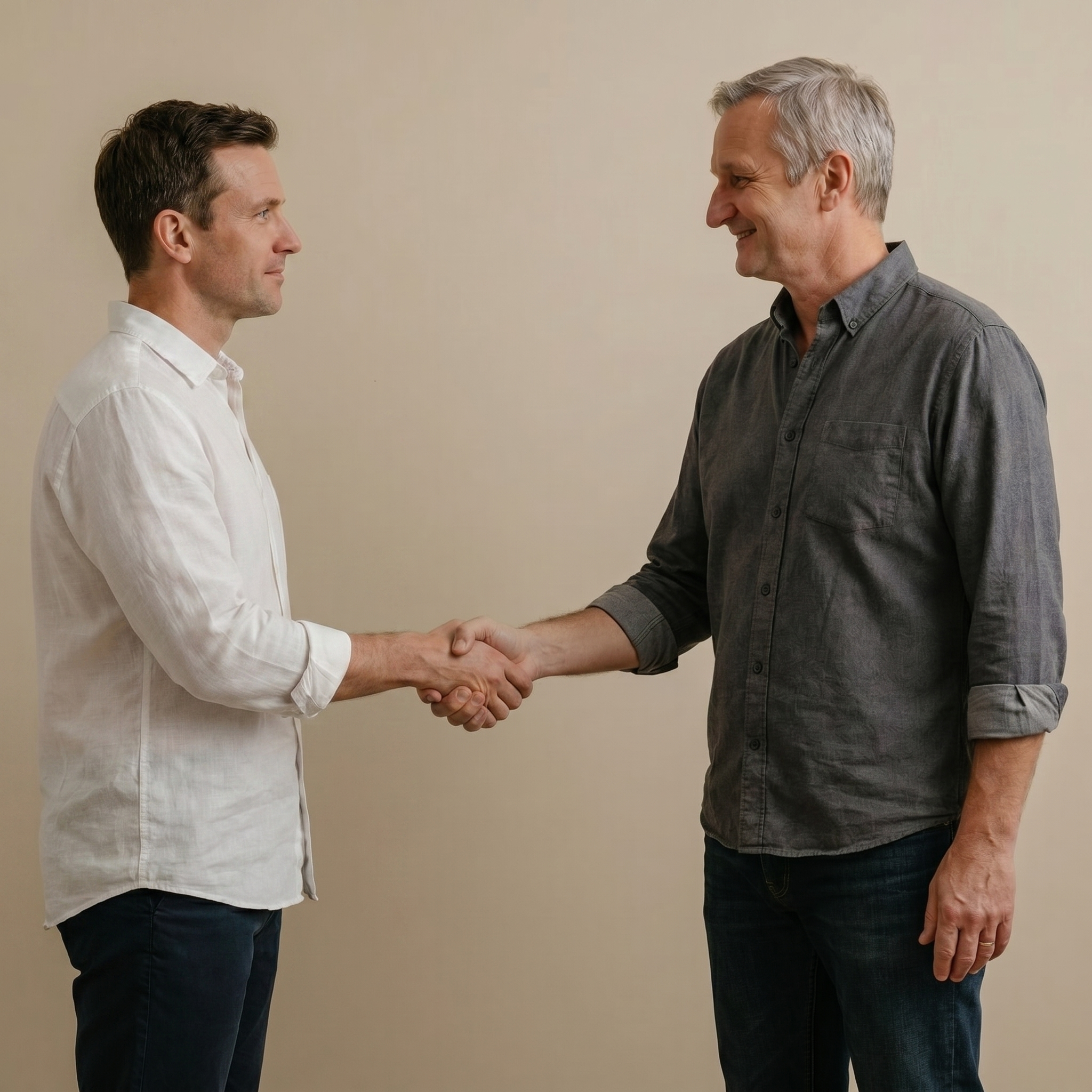
In medicine, the doctor is often the one who “fixes” things. With PRT, it’s different. I’m your guide and I provide you with the neurological map—but you’re the one who walks the path.
I use the method developed by Alan Gordon, the pioneer of Pain Reprocessing Therapy. Thanks to my training and certification as a PRT therapist, I am familiar with the tools we can use to make this process as efficient as possible.
But the real work doesn't happen in my office—it happens in your everyday life: the moment you feel pain and decide to face it with confidence rather than fear. My job is to guide you as you rediscover this ability.